
Stances
Standing, sitting, strapped in: three ways to ride and who each one is for
We organize our catalog by how the rider meets the swing rather than the number on a birthday card. Weight ratings and riding positions separate standing decks, traditional seats and molded shells across 5 sections.
Riding upright on a board
Exactly 4 of our swings are ridden standing up on a deck. Staying upright on one takes balance because the rider holds a rope in each hand while pumping with both legs. Only 2 of those stand-up decks are maple. Those maple boards are flat and tapered, while the plastic deck and the pressed bamboo deck have curved shapes underfoot. A deck demands more physical work from the rider than any seated design, and it does not accommodate a passive passenger.
The stance mimics a board sport on a hanging pendulum. Riders shift their weight from edge to edge to steer the arc through the air. That mechanical demand means these decks suit riders who already hold their own weight easily and want an active session rather than a stationary perch. A flat deck provides a broad base for both feet, while the curved options lock the stance deeper into the center line.
Three distinct seating styles
A total of 8 are ridden sitting down, on a disc, a molded seat or a belt swing. These three styles handle movement differently. A belt swing cradles the hips and swings in a straight line back and forth. A molded seat gives a rigid base that holds its profile under load. Our maple disc has a curved seat rather than a flat one, and it hangs from a single rope that allows rotation in every direction.
The disc turns on its axis while it travels, which produces a completely different path through the air compared to a two-rope belt swing. Belts are flexible and pinch inward when loaded, while molded seats keep their width open. None of these options require the rider to stand, but they still ask the hands to grip the ropes directly throughout the entire swing arc.
One of each, side by side
The most-rated listing from every stance, plus the gear that gets any of them onto a branch.
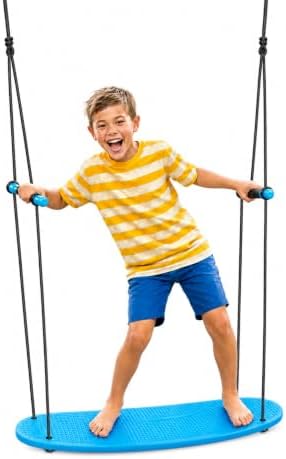 Holds 200 lb
Swurfer Kick Stand Up Tree Swing
Stand on the molded blue deck, grip the handles, and carve wide arcs through the air beneath your backyard branch.
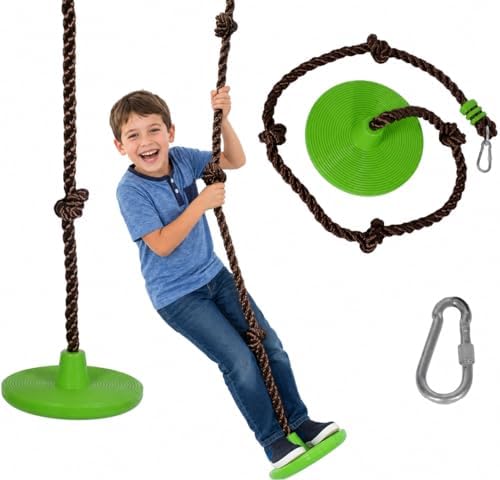 Holds 200 lb
Swurfer Disco Tree Swing
A molded plastic disc swing with climbing knots along the rope, built for sitting, standing, and soaring from a backyard limb.
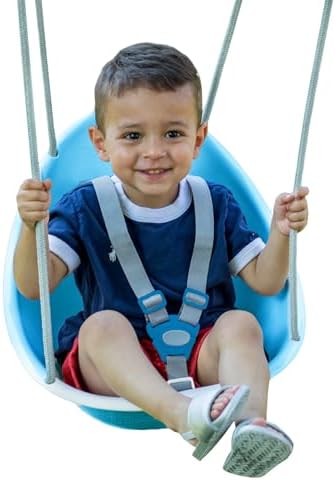 Holds 50 lb
Swurfer Coconut - Your Child's First Swing with Soft Braided…
Molded for small riders nine months and up, this blue shell seat hangs indoors or from a backyard tree limb with soft braided rope.
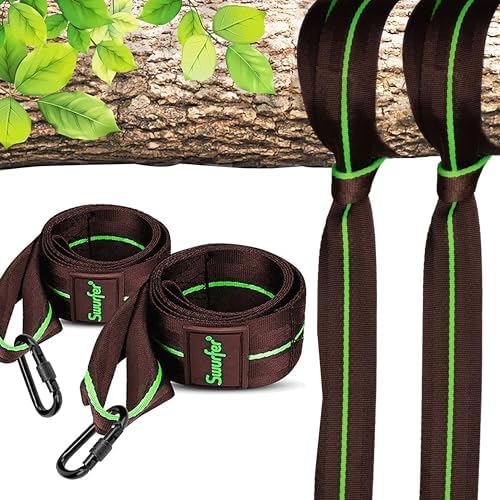
Swurfer Tree Swing Hammock Straps –Hanging Kit for Hammock
Heavy polyester webbing and steel carabiners rated to hang hammocks and swings from high branches and beams.
Harnessed shells for early riders
Another 4 are molded seats with a three-point harness. We mold these high-backed shells for riders who cannot yet hold on by themselves. A three-point harness buckles over both shoulders and between the legs to keep the rider centered in the bucket. The shell takes over the work of holding the torso upright when grip strength is still absent.
The trade with a harnessed seat is longevity. Because the rigid shell matches a smaller torso and sets a strict physical boundary, riders outgrow these models much sooner than an open belt or a standing board. They serve a specific early window when a child wants to swing without having to grip a line.
Hardware and hanging gear
The remaining 7 items are hanging gear rather than a swing. This group includes our hanging straps, tree brackets and replacement ropes. Every swing needs a solid connection point on a live limb or a sturdy horizontal frame, and the hardware must match the hanging style of the seat, whether it uses one anchor point or two.
A single overhead anchor allows a disc to twist freely, while two spaced hanging points keep a standing deck or belt swing tracking on a straight track. Matching the straps and ropes to the tree branch keeps the swing hanging at the proper height off the turf.
Every build begins with the posture of the rider, balancing the physical demand of a deck against the support of a molded shell.