
Choosing
We ask what the rider weighs before we ask how old they are
Every listing in our catalog leads with numbers about the wood, plastic and rope rather than a birthday. A scale tells you how the timber holds up, while a calendar only guesses at the rider.
What our product listings actually count
Look across our range and the pattern is plain to see. We make 23 swings and pieces of hanging gear, and 21 of our listings state a weight limit in pounds. Only 16 of them state a minimum age. That split is deliberate on our part. We test what the ropes hold and what the timber carries, so pounds are the numbers we print first.
The ratings across our range run from 50 pounds up to 300 pounds. That top mark of 300 pounds belongs to a piece of hanging gear rather than a swing. For the boards riders stand on, our stand-up decks are rated to 200 pounds. Those numbers measure the physical gear, not the person riding it.
Where a birthday falls short
An age on packaging is an estimate based on an average child, but real riders do not grow on a fixed chart. Two children sharing the same birthday can weigh vastly different amounts by their next summer. Building hardware around a calendar year means relying on assumptions that break down the moment a tall rider steps onto the board.
A weight limit is an exact number about the equipment. It tells you the load the hardware takes without guessing how tall someone stands. When we cut a board or stitch a strap, the scale is the only measurement that describes how the materials respond under tension.
The ladder of stated limits
Every swing here prints a number in pounds. They are ordered from the lightest rating up.
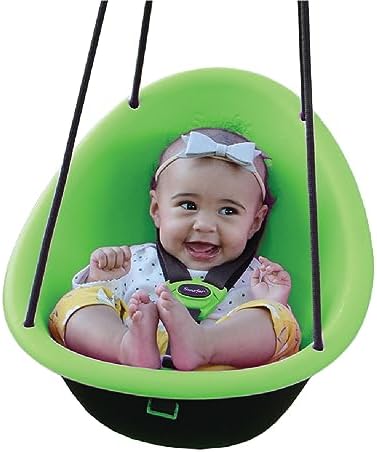 Holds 50 lb
Swurfer Kiwi Toddler Swing
A foam-lined molded seat with an adjustable three-point harness and soft braided rope, built for toddlers nine months and up.
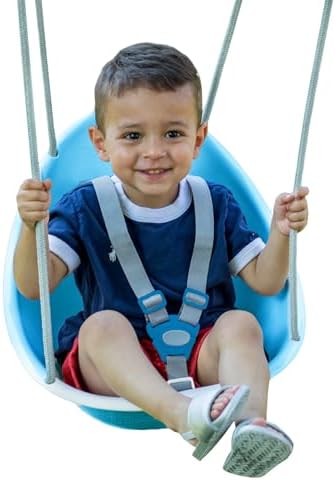 Holds 50 lb
Swurfer Coconut - Your Child's First Swing with Soft Braided…
Molded for small riders nine months and up, this blue shell seat hangs indoors or from a backyard tree limb with soft braided rope.
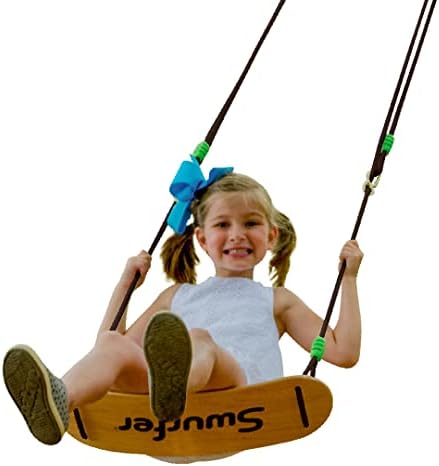 Holds 150 lb
Swurfer Tree Swing, Swing Sets for Backyard, Outdoor Swing -…
A solid maple plank swing cut for backyard branches, built with soft braided rope and rated for riders up to 150 pounds.
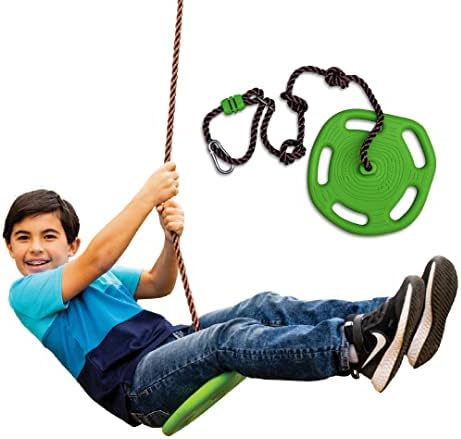 Holds 150 lb
Swurfer Disco Tree Swing
A rugged molded plastic disc on an adjustable climbing rope, built for kids four and up to sit, stand, or climb in the backyard.
The limited role of age brackets
Stating an age is not entirely useless, but it answers a different question from load capacity. The youngest age we state anywhere is 9 months on our toddler seats, while the oldest starting age is ages 6 and up on boards. Those numbers simply give a rough guide to whether a child can sit upright and hold the handles.
Age gives a broad hint about grip and posture, but it cannot tell you if a deck will support a rider. Weight handles the structural question alone. Once hands can grasp the ropes, the scale becomes the single number that matters when picking out the seat or the deck.
Matching shapes to how riders move
Knowing the shape of the deck prevents mix-ups before hanging the ropes from a limb. Our curved maple boards are sit-down swings and are not made for standing. If you want a maple deck to stand on, we cut that as a flat tapered skate deck, while our curved stand-up boards are molded from plastic or shaped from bamboo.
Every material responds in its own way to foot placement and body motion. A flat wooden deck needs two feet planted firmly across the grip, while a curved seat invites the rider to sit down between the ropes. Matching the stance to the deck shape comes down to how someone rides, not how many years they have lived.
Pounds measure what the ropes hold, while birthdays only guess how large a child might be this season.